Care for a Linen Garment While Respecting Its Construction
Linen care still begins with the finished article’s label. Check lining, trims and any blend, then plan washing, drying and pressing as one supported routine.
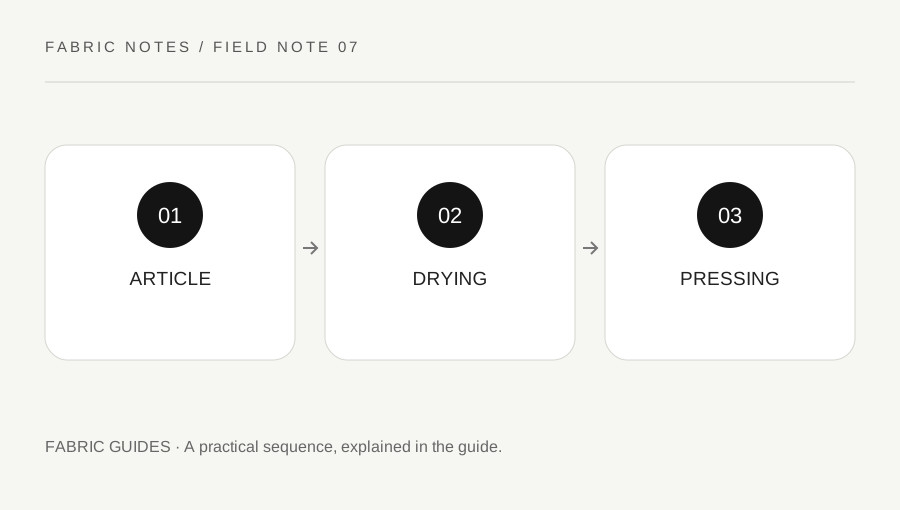
Original explanatory diagram. Examples illustrate a method or decision; they are not claims of personal testing.
Identify the garment beyond the fiber word
Read the composition and complete care instructions. A lined linen jacket, a blended shirt and a plain table textile are different articles even when linen appears in all their descriptions. Do not use a generic fiber recommendation to override tailoring, trims or a professional-care instruction. Keep exact-item manufacturer information where available.
The Alliance for European Flax-Linen and Hemp provides background on linen care, while the garment's own instructions remain essential. Decide whether the task is ordinary cleaning, a localized stain or pressing an already clean item. Each question may need a different step, and not every crease is evidence that the whole garment needs another wash.
Prepare a compatible permitted wash
Inspect the article, empty pockets and check closures and existing damage. Use pretreatment only if compatible with both labels and tested as instructed. Keep color and construction compatibility in the load, and choose a program the care label permits. Do not crowd the machine or assume that a robust-looking cloth needs an aggressive mechanical process.
Measure detergent through its actual directions. Avoid improvised mixtures and do not treat a stain with every product available before identifying it. If the label is missing or the article is structured and valuable, seek suitable professional advice. A modest supported routine is easier to assess than a sequence of treatments whose combined effect is unknown.
Work through a shirt-care plan
Imagine a linen-blend shirt permits a particular machine process and a restricted drying method. The owner prepares the drying space before washing, follows the label and arranges the garment gently afterward. They inspect seams and the collar rather than twisting it forcefully to hurry the process.
If pressing is permitted, they use the label's limit and the iron instructions, protecting any sensitive detail appropriately. The example does not prescribe one temperature or claim that every linen article should be handled identically. It shows how to carry the same care boundary from wash through finishing instead of treating the dryer and iron as unrelated decisions.
Choose appearance preferences within the limits
Some people prefer a relaxed wrinkled appearance, while others want a more pressed result. Keep that preference separate from the permitted care process. Do not apply an unsupported high heat simply because you want a smoother surface. Read steam and ironing restrictions, and test an appropriate discreet area where the guidance calls for it.
Store the item appropriately once it is ready and keep a note of any special construction or finish. If shape or surface changes after care, compare the actual routine and starting condition before assigning one cause. A useful linen habit respects both the fiber context and the complete garment, allowing personal appearance preference without pretending a universal internet setting suits every item.
Do not use dampness as a storage shortcut
A garment prepared for a permitted pressing step is not automatically ready to be folded into a closed cupboard. Finish the appropriate process and check that the item is ready for storage under its care requirements. Keep unfinished and finished laundry distinguishable when several people help. This small workflow distinction prevents a practical pressing preference from becoming an overlooked damp-storage problem, and it keeps the next user from assuming that a neatly folded article has completed every stage.
A practical checklist
Choices are saved in this browser. Reset them here or clear this site’s browser storage.
Questions that come up
Can every linen garment follow a plain linen-cloth routine?
No. Blends, tailoring, lining and trims can change the complete article’s care requirements.
Does a crease mean the item needs washing?
Not necessarily. Assess the actual cleaning need and use a permitted finishing method if appropriate.
Can I ignore the ironing limit for a smoother result?
No. Follow the garment and iron instructions rather than overriding them for appearance.
References & scope
Background references checked on 18 October 2026. Worked examples and diagrams are original teaching material.