Read the Whole Garment Care Label Before Choosing a Cycle
A fiber name does not describe every part of a garment. Read washing, drying and finishing instructions together so a successful wash is not followed by an unsuitable drying or ironing step.
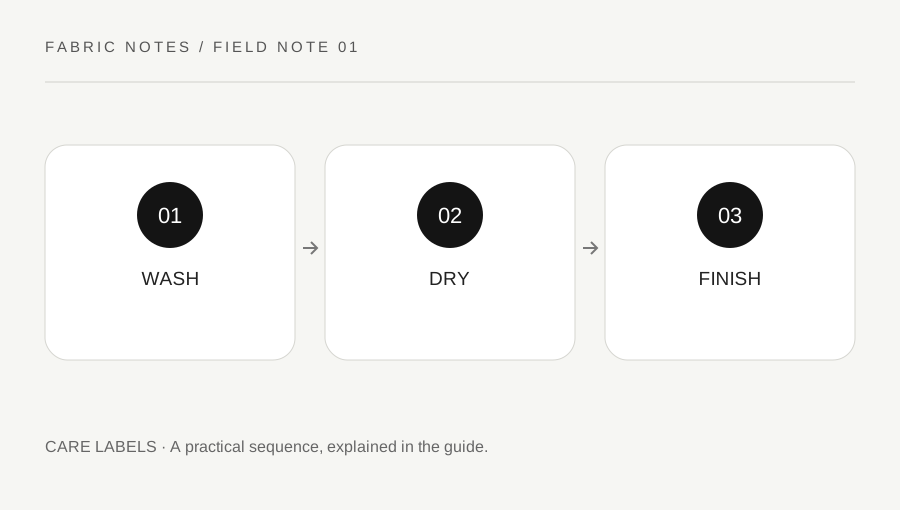
Original explanatory diagram. Examples illustrate a method or decision; they are not claims of personal testing.
Find both composition and care information
Look for the fiber composition and the care instructions, which may be on separate labels. A cotton-rich garment can still contain elastic, lining, trims or finishes that affect its care. Do not select a hot cycle solely because one familiar fiber appears first in the composition. The garment's instructions address the assembled article rather than a generic piece of fiber.
Read any written warnings alongside symbols. Keep a photograph if the label is difficult to reach, but do not remove it simply to make future sorting faster. If it is missing or illegible, identify the exact item through the manufacturer where possible. An uncertain label is a reason to seek information, not to choose the most aggressive treatment available.
Read the treatment sequence as a whole
GINETEX's guide explains the categories of washing, bleaching, drying, ironing and professional care. A number in a wash symbol is a limit under that system rather than an instruction that every wash must use the maximum. Bars and other details can change the permitted mechanical process, so inspect the complete symbol instead of only the temperature.
Check drying before starting, especially if the item needs a flat surface or another arrangement you cannot provide immediately. An article that is allowed in a washing machine is not automatically suitable for a tumble dryer or a hot iron. Keep bleach permission separate from the decision to wash. The source's actual symbol guide is more reliable than guessing from a simplified memory of the shapes.
Work through a mixed-construction example
Imagine a shirt's outer fabric is familiar but its care label calls for a mild process and restricted drying. The owner follows those limits rather than choosing a general cotton program. They check the machine's manual to understand which setting corresponds to the permitted treatment and prepare the drying space first.
If a stain needs pretreatment, they choose a product compatible with the garment and test as instructed. They do not let the stain concern override the label. This is an illustrative workflow, not a recommendation for a particular shirt or machine. The important habit is to treat care instructions as a complete set of boundaries around the entire routine.
Keep uncertainty visible in shared laundry
If several people handle laundry, place an uncertain or restricted item in a clearly understood separate location. A short note can identify the care requirement without exposing private information. Avoid leaving a delicate garment in an ordinary mixed basket while expecting another person to remember a special conversation.
After cleaning, inspect the item before applying heat or putting it away. Record any result that changes your understanding of its care, and ask the manufacturer or a suitable textile professional when a problem persists. A useful label-reading routine prevents avoidable mismatches and makes the next wash easier without pretending that one fiber name or one machine button answers every care question.
Use the correct symbol reference for the label
Care systems can differ in presentation, and a damaged or partial symbol can be easy to misread. Compare the actual mark with an appropriate current guide instead of treating any circle, square or dot as interchangeable. Do not redraw a missing instruction from memory and then rely on your drawing as evidence. If the manufacturer supplies written care for the exact item, keep that reference with your private note. The goal is a supported decision, not a fast guess that happens to work once.
A practical checklist
Choices are saved in this browser. Reset them here or clear this site’s browser storage.
Questions that come up
Does machine washable mean tumble dryable?
No. Read the drying instruction separately and follow the garment’s complete care guidance.
Must I always use the maximum stated temperature?
A maximum is a limit, not an automatic target for every wash. Use an appropriate permitted process.
Can fiber content replace a missing label?
Not reliably for a complete garment. Seek exact-item information or suitable professional advice.
References & scope
Background references checked on 18 October 2026. Worked examples and diagrams are original teaching material.