Test a Laundry Product on a Hidden Area Before Treating a Visible Mark
A hidden-area test can reveal an obvious incompatibility, but it is not a guarantee for every part of a garment. Read both labels and keep the test small, controlled and within instructions.
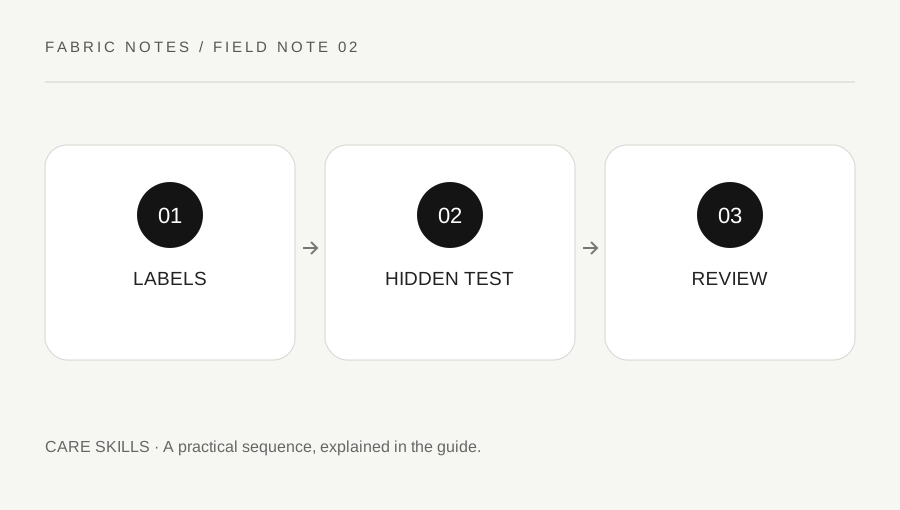
Original explanatory diagram. Examples illustrate a method or decision; they are not claims of personal testing.
Check whether the treatment is permitted at all
Read the garment care instructions and the product's fabric exclusions, use directions and handling requirements. A hidden-area test does not authorize a product that the label excludes. Delicate fibers, coatings, trims and dyes may need a different route. If the item requires professional care or has a valuable unknown finish, ask an appropriate textile professional before experimenting.
Identify the stain as well as the garment. A product intended for one problem is not automatically useful for another. Avoid combining several products to make a stronger treatment. Keep original containers and directions available so the test is based on what the manufacturer actually permits rather than an unlabeled liquid in a reused bottle.
Choose a genuinely discreet representative area
Follow the product's instructions for the test location, amount, contact time and removal. A seam allowance or inner area may be useful when it is representative, but a lining made from another fabric does not test the outer garment's dye. Consider trims separately if the treatment could reach them. Protect the surface underneath using a suitable clean material.
Inspect for color transfer, texture change or another adverse result under the instructed conditions. Keep the test small and do not rub aggressively to force an answer. If the instructions call for rinsing or drying before assessment, complete that step. A wet area can look different from a dry one, so compare at the relevant stage rather than deciding immediately from a darker damp patch.
Work through a pretreatment example
Imagine a washable colored top has a small visible stain. The owner confirms the proposed product is compatible with the care label and tests a discreet area through the product directions. They use a clean backing and watch for color transfer or a surface change before applying it to the visible mark.
If the test looks adverse or uncertain, they stop and choose another permitted route or ask for advice. They do not keep treating the visible stain on the assumption that a stronger dose will solve both problems. This example is a method rather than a promise that a passed test guarantees uniform dye behavior across a whole item.
Keep the result and the limits clear
Record which product and method were tested if the garment needs repeated care. A later product reformulation or a different concentration is not the same test. Do not generalize from one garment to every item with the same fiber name, because construction and dye can differ. Keep the result linked to the exact item and routine.
After the full permitted treatment, inspect before heat drying or ironing. A mark that remains or a change in texture may need another decision. Avoid escalating through several unfamiliar treatments without reviewing the labels. A useful test routine reduces obvious risk while preserving the honest limit that a small hidden area cannot establish every possible outcome on a complex garment.
Stop when the test itself creates uncertainty
If the tested area becomes rough, stiff, discolored or otherwise different, do not explain it away merely because it is hidden. Keep the packaging and describe the exact method to the manufacturer or cleaner if help is needed. Do not attempt a second improvised chemical correction before understanding the first result. A small stopped test can prevent a larger visible problem, and choosing professional advice is a practical outcome rather than evidence that the garment has defeated a routine household task.
A practical checklist
Choices are saved in this browser. Reset them here or clear this site’s browser storage.
Questions that come up
Does a passed spot test guarantee the whole garment is safe?
No. It is a limited compatibility check and does not override exclusions or account for every trim and dye area.
Can I test the lining instead of the outer fabric?
Only if it genuinely represents what you will treat. Different lining material may not answer the question.
Should I mix products if the first test is weak?
No. Follow labels and do not improvise stronger mixtures.
References & scope
Background references checked on 18 October 2026. Worked examples and diagrams are original teaching material.